

Introducing a One-of-a-Kind Study Abroad Experiential Learning Program

Photo by Pixabay from Pexels
Are you ready to embark on a life-changing study abroad journey of an adventurous and impactful experiential learning opportunity that will not only transform your education and bucket list but also shape the future of our planet and enhance climate action?
Then, let’s introduce you to a Study Abroad Program by North South Field Studies Safari (NSFSS), an international third-party education provider headquartered in Australia. We partner with eminent universities in Africa to deliver field-based experiential learning. And in Kenya, we’ve partnered with a leading public institution, Pwani University, to offer a memorable academic safari to interested students worldwide.
About the NSFSS Beach to Bush Study Abroad Program
Imagine immersing yourself in experiences that expand your horizons, and making lifelong connections with global peers. You’ll also get first-hand climate change education. Furthermore, you’ll study human-wildlife interaction, positioning yourself to formulate impactful environment management policies. All this while also enjoying Kenya’s touristic sites, culture, ecosystems, breathtaking landscapes, and unique wildlife.
This program, dubbed Beach to Bush (B2B), will traverse several regions. You’ll be spoilt for choice, from the rolling savannahs to lush rainforests and stunning coastal regions. Besides, the field studies will also cover the following extraordinary areas:
-
- Massive mangrove ecosystems
- Human-wildlife conflict hot pots
- Mega developments
- Small-scale fisheries
- First-hand interactions with the Big Five
- Protected spaces
- Immersive one-on-one interactions with local communities, including the Masai.
Moreover, Kenya holds seven UNESCO World Heritage sites! Like no other country, this attribute offers a rich tapestry of environments, each teaching its lesson in sustainability. You’ll indulge in an experiential learning process that studies first-hand industry and community-based mitigation initiatives for adaptation and climate change, including the blue and green carbon schemes. You’ll also study how local communities cope and adapt to climate change and sustainable development.
Why Study Abroad?
We live in a constantly evolving world with shared global challenges. This feature prompts an interconnectedness that demands collective solutions. Therefore, a learning adventure that helps you understand the impact of these challenges at local places and reflect on global solutions can help achieve the desired innovative answers.
And Why Kenya?
First, at a country level, Kenya recently hosted the UNFCCC’s Africa Climate Week. The summit explored critical climate issues, including green carbon, decarbonization, net zero and climate financing. Secondly, Kenya is one of the African countries on the receiving end of climate change impacts. Consequently, the country experiences droughts, floods and biodiversity decline, significantly impacting her social and economic well-being. Lastly, our B2B program showcases key complementary SDGs, including 14 on life on water, 6 on poverty and 13 on climate change, to support this unique background.
As a result, many international policies rely on countries like Kenya for their successful implementation. For example:
-
- The Global Biodiversity Framework on achieving harmony between humans and nature by 2050
- The UNFCCCs PARIS Accord on climate change
- Sustainable Development Goals (SDGs)
These attributes make Kenya the perfect model for experiential learning. You’ll learn first-hand how developing countries are affected by and coping with climate change issues as they pursue sustainable development.
Examples of Kenyan Sites for Environmental Management and Sustainability Studies
Prepare for mind-blowing experiences from various educative sites. The list is endless from world-renowned parks to organisational initiatives, cultural immersion, charming coral reefs and adventurous activities. Here’s a peek at the educational escapades and settings that await.
The Nairobi National Park
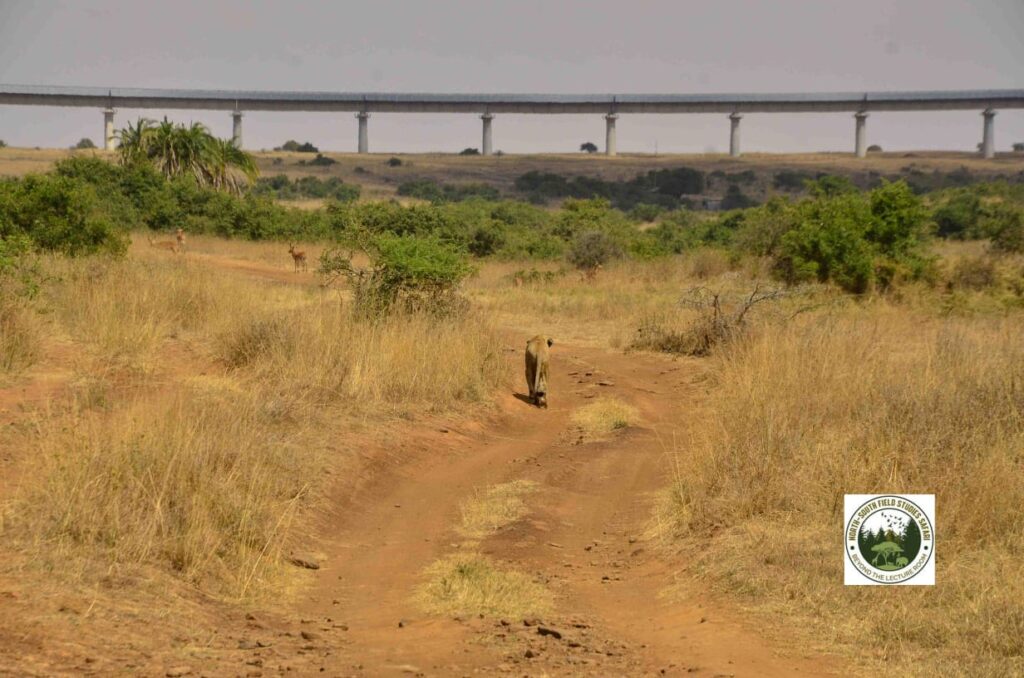
An image of a lion strategising for a kill, and the railway in the background
Nestled only seven kilometres from the city centre is this infamous world’s only Wildlife Capital. This rolling grassland is awash with wildlife and unique vegetation, with Kenya’s mega infrastructural development—the railway—cutting through it. And towering in the backdrop are skyscrapers, five-star hotels and a motorway. Furthermore, the park is underneath a flight path; a game drive features several occasional low-flying aeroplanes headed for landing.
Beautiful wildlife leisurely roam oblivious of the surrounding complexities, a phenomenon that provides an abundantly enlightening learning safari. It’ll give you a glimpse of today’s environmental management and sustainability complexities. Additionally, the park offers insight into wildlife protection initiatives while realizing economic growth.
The setup begs the question of whether the infrastructure pollutes the park. Does the train and plane disturb the inhabitants? What’s more, Kenya is famous for lions breaking out of the park and roaming the highway; does this mean the activities blocked the wildlife’s migratory corridors and evoked human-wildlife conflicts? A dry riverbed here and a watering hole there with hippos as game watchers stare, and a plane flies past. This spectacle sheds light on human activities and economic developments’ interference with natural resources and environmental flows, with effects like depleted water towers.
The Nairobi Arboretum Forest
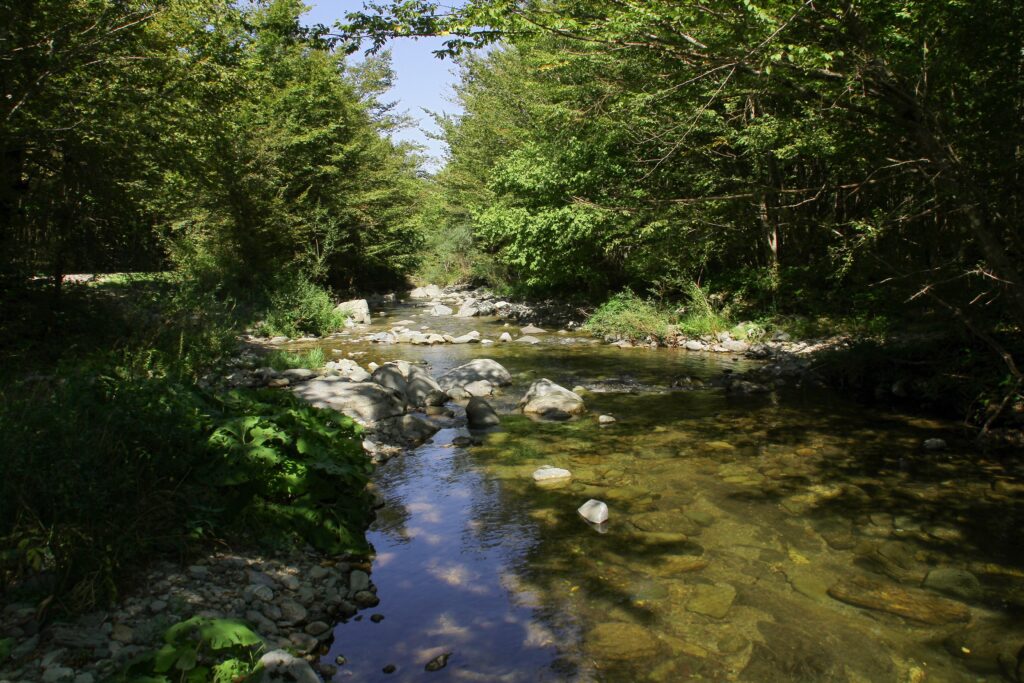
Photo of a forest by Georgi Kanov from Pexels
A green space within a 3 km radius of the Central Business District and affluent residential and economic neighbourhoods is Arboretum Forest. This tranquil woodland houses a river that joins others downstream, traversing several regions to the Indian Ocean. At the edge, there’s a significant apartment development. And a few meters across the fence, there’s a coffee shop, a road, and a petrol station. Not to mention the occasional litter along the riverbank. This scene will give you insight into the following concepts:
-
- Competition between the built and natural environments.
- Socio-economic development Vs. Conservation conflicts.
- Food and water systems studies
- Land and ocean interactions
- Sustainable development
These are just a few of Kenya’s distinctive heritage, which will be your outdoor adventurous classroom. And to back the field studies is world-class academic content. The facilitation team features high-achieving professors who have taught, researched, published and led forums on environmental management, conservation and climate change. Ultimately, they’ll put you at the forefront of enacting real-life solutions.
What Terrific Benefits Will Our Field Studies Safari Students Enjoy?
So, can you imagine how much adventure and immersive learning await? You’ll enjoy a one-of-a-kind terrific six-week journey that delves deep into incredible lessons and experiences, including the following:

Photo by Karolina Grabowska from Pexels
1. You’ll Gain Life-changing Field-based Lessons
Our B2B program will furnish you with several benefits from personal adventures to mesmerising encounters. Among the incredible unequaled lessons you’ll gain are in the following areas:
- Environmental management and sustainability studies
- Human health
- Global mitigation measures at local places
- Environmental impact assessment
- Global environmental change (GEC)
- The concept of ecosystem services and natural capital
- SDGs and inter-sectoral relationships
- Plastic pollution in the context of the circular economy
- Gender disparity in developing countries
- The competing priorities between economic development and environmental protection
2. The Beach to Bush Program Will Mould You Into a Thought Leader
The resulting lessons will put you on the front lines to witness real-world challenges and solve problems. Eventually, you’ll gain invaluable insights to mould you into a thought leader who can develop practical climate action solutions and policies related to ecosystem and nature-based solutions. The knowledge will also help you formulate climate risk management and emissions reduction strategies.
3. Earn Transferable Credits
Now, here’s the icing on the cake. The NSFSS program comes with transferable credits. Moreover, your home institution can consider this attainment for RPL (recognition of prior learning) to fast-track your education. We don’t offer just a study abroad but an investment in your future and education!

Photo by RDNE Stock project from Pexels
Benefits of the NSFSS Study Abroad Program to Universities
Now, universities, imagine the opportunities for your institution. Partnering with us opens doors to a diversified education and knowledge world, widening your reach and strengthening your reputation. We’ll connect you to a region with groundbreaking research opportunities and a wealth of expertise. This remarkable partnership will also open doors to investigating and formulating collaborative solutions from a global perspective.
Join Us Today for the Experiential Learning of a Lifetime
In conclusion, whether you’re an adventurous student seeking an immersive state-of-the-art transformative education that lets you learn while ticking your bucket list and earning extra study credits, a parent who wants beyond the ordinary for your child, or a university ready to make meaningful partnerships, research and a lasting impact; our 6-week B2B Study Abroad Program in Kenya is for you. We’re your gateway to adventures, top-notch education, unmatchable experiences and memories. We also present a second-to-none opportunity to engage in reflections and expand your eco-cultural worldview.
So what are you waiting for? Let’s change the world, one student, one partnership at a time. How? Visit our website or contact us now to enrol.
N/B: This article is written by human writers and not automated AI system
